
The Tarragona Aqueduct, also known worldwide as the Les Ferreres Aqueduct or Devil’s Bridge, is one of the most spectacular civil engineering works of ancient Rome in the Iberian Peninsula. Originally built in the 1st century AD (during the reign of Emperor Augustus), its mission was vital: to supply water from the Francolí River to the splendid Tarraco, capital of Hispania Citerior.
Today, this monument is not just a relic, but a symbol of the Costa Dorada that attracts thousands of visitors for its majesty and natural surroundings.
Contenidos:
Les Ferreres Aqueduct in Tarragona: World Heritage Site
This imposing arcade located on the outskirts of the city has been designated a UNESCO World Heritage Site. Its state of preservation is so exceptional that you can walk along its upper section, offering a unique experience.
- Dimensions: It measures 217 meters long and reaches a maximum height of 27 meters.
- Structure: It features two levels of superimposed arches built with stone blocks joined without mortar (dry construction).
- Roman Precision: There is a gradient of barely 40 centimeters between the northern and southern sections to allow water to flow by gravity along its original 10 km route.
To ensure water could flow properly through the Tarragona Aqueduct, Roman engineers designed a gradient of barely 40 centimeters between the northern and southern sections, demonstrating astonishing precision for the era.
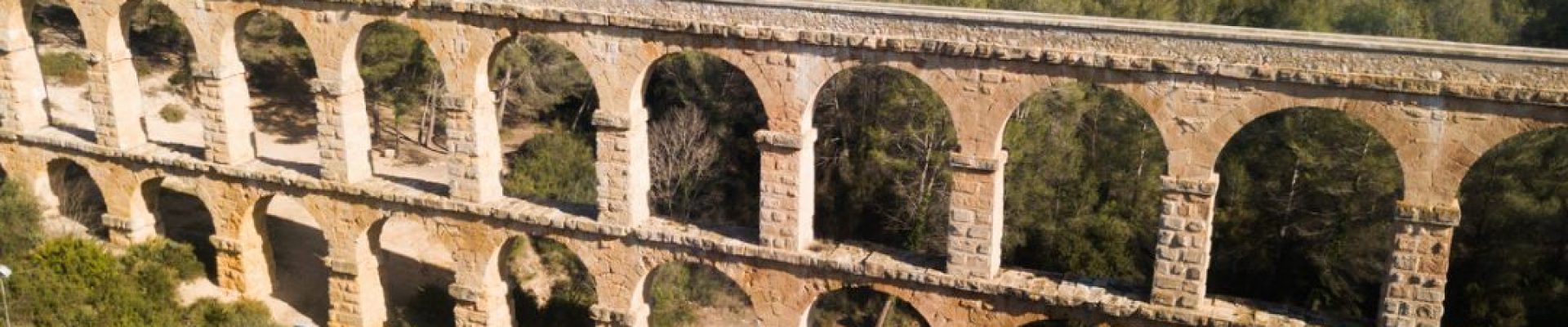
Tarragona Aqueduct: discover its history
Although the Les Ferreres Aqueduct transported water from areas like El Rourell (92 meters above sea level), its popular name, “Devil’s Bridge,” comes from an ancient legend. It was said that the devil built it in a single night after losing a bet against a maiden.
Beyond the myths, the Tarragona Aqueduct was a fragment of a 10 km network of channels. This magnificent work remained operational well into the 18th century, being a fundamental pillar for the survival of ancient Tarraco. It is undoubtedly a key attraction to see if you’re planning a family vacation on the Costa Dorada.
What to do around the Les Ferreres Aqueduct?
Around the Tarragona Aqueduct, the Devil’s Bridge Eco-Historical Park has been created, ideal for complementing your cultural visit with nature:
- Hiking: Marked trails surrounding the Les Ferreres Aqueduct.
- Photography: Unique perspectives from the lower trails to capture the magnitude of the arches.
- Tarraco Viva: During this Roman festival, the Tarragona Aqueduct takes center stage with historical reenactments.
It’s a perfect excursion for those staying in our vacation apartments on the Costa Dorada looking for alternatives to the beach, such as discovering what to see in Mont-roig del Camp.
How to get to the Tarragona Aqueduct?
The monument is located about 4 km from the city center, in the Sant Pere i Sant Pau area. Here are the best options:
- By car: Access via the N-240. There is free parking available for visiting the Les Ferreres Aqueduct.
- By bus: Lines 5 or 85 from downtown Tarragona (“Pont del Diable” stop).
- From the Airport: If you’re coming from Barcelona-El Prat, you can reach Tarragona station by train and from there take a local bus to the Tarragona Aqueduct.
Frequently Asked Questions about the Les Ferreres Aqueduct (FAQs)
Yes, access to the park and walking along the Les Ferreres Aqueduct is free and open year-round.
Yes, the upper channel is open for walking from one end to the other, offering the best views of the park.
Yes, it’s a short drive from our main vacation destinations, making it a must-see.


